Sunday, 20 May 2018

New Details Emerge of British Airways A380 “Fume Event” in Which 26 Were Treated for Smoke Inhalation

More Details Emerge of Serious British Airways A380 "Fume Event" in Which 26 Were Treated for Smoke Inhalation
New details have emerged of what could have been a serious “fume event” onboard a British Airways aircraft flying from San Francisco to London Heathrow on the 24th October 2016.  The Airbus A380 superjumbo, carrying 388 passengers and 25 crew, was forced to divert and make an unscheduled landing due to a medical emergency after a “strong obnoxious smell” entered the passenger cabin.
The aircraft made an impromptu landing in Vancouver less than two hours after departing San Francisco, where 25 patients, including 20 cabin crew and five passengers, were transported to hospitals across the city.  Some of the patients reported feeling sick from breathing in “toxic fumes” and local authorities said they were suffering the effects of smoke inhalation.
Unsurprisingly, the Canadian Transportation Bureau (TSB) opened an investigation to find out exactly what had happened, but after extensive “troubleshooting” no faults with the aircraft could be found.  The A380, registration G-XLEB returned to service a short time later and remains flying passengers today.
Now, the Aviation Herald says it has recently received further information about exactly what happened on that flight:
“About 40-50 minutes into the flight an odour of glue type and burning plastics was detected near main deck door 4L. A family nearby had just oblate oil on their baby, however, the smell of the oblate oil was different to the odour detected near the door,” the AVHerald reports.
A short time later, a member of cabin crew who was in an upper deck galley started to vomit.  Other flight attendants started to check their surroundings, including ovens and the trash compactors, in a desperate attempt to work out what was causing the smell.

“Suffering headaches, dizziness, lightheadedness, nausea”

Before long, the AVHerald says “other cabin crew members began to perform abnormally” and complained of suffering headaches, dizziness, lightheadedness, nausea and having a metallic taste in their mouth.  The report claims the flight attendants “showed itchy red eyes and became increasingly forgetful, aggressive and confused.”
By the time the Captain decided to declare a medical emergency and divert, 12 cabin crew were suffering ill effects and one had even been put on oxygen.  Other cabin crew were frantically talking with Medlink, an aviation medical advice service with specially trained Emergency Room doctors who can provide advice and support.
But here’s where things get really concerning.  The AVHerald reports:
“Cabin crew were slow in responding to the diversion and prepare the cabin due to inability to function normally and needed to be queried and guided by other crew.  After the diversion was changed to Vancouver, which added another hour of flight time, 8 cabin crew were able to get on oxygen, a few other cabin crew went to go to the toilet but were subsequently found anywhere else in the aircraft but the lavatories.”

“Close to being incapacitated”

“Cabin crew became concerned they couldn’t cover the doors for landing with that many cabin crew already affected and close to being incapacitated.”
Once safely on the ground, paramedics became concerned with all the cabin crew and insisted they all be transported to local hospitals for assessment.  The crew were declared fit to fly as passengers the following day.
While the cause of this incident still remains a mystery today, it again raises serious questions about so-called ‘aerotoxic syndrome’.  The Unite Union which represents many British Airways cabin crew says it is currently pursuing over 100 legal cases on behalf of crew who say they’ve been involved in fume events and subsequently suffered ill-health.

Aerotoxic syndrome?

The issue of toxic cabin air, which has long been ignored by the aviation industry, was forced into the spotlight when Matthew Bass, a 34-year old flight attendant for British Airways died unexpectedly several years ago.  A British Coroner has recently ruled Bass died after suffering a cardiac arrest – possibly triggered by alcohol consumption.
The Daily Mail reports that “Mr Bass had gone into cardiac arrest after aspirating, caused by a high alcohol intake.”
However, his parents had believed Matthew was suffering from aerotoxic syndrome.  They paid for a second post-mortem which revealed he had toxins called organophosphates in his body.  These toxins are found in things like aircraft engine oil and when heated they could enter an aircraft cabin as fumes.
Yet, after a lengthy inquest, no link could be found between Matthew’s death and aerotoxic syndrome or the organophosphates.  Berkshire senior coroner Peter Bedford explained:
“What is clear to me and that is now accepted, to the family’s credit, is that none of the evidence available to me, for a variety of reasons, is that the cause of Mr Bass’s death can, on the balance of probabilities, be in any way explained by the exposure to organophosphates, or any form of poisoning, that led to aerotoxic syndrome.”
In the future, additional testing might be requested when aerotoxic syndrome is suspected as the cause of death.  The coroner, in this case, said he will write to the Chief Coroner and ask him to consider alerting other coroners in England and Wales of requesting further tests in similar cases.

“The airline industry needs to face up to it”

“Toxic cabin air is real and is damaging lives. The airline industry needs to face up to its responsibilities and deal with it,” commented Unite’s assistant general secretary for legal services Howard Beckett.
“This significant step by a senior coroner recognises that exposure to toxic cabin air does have an impact on the body and can lead to ill health.  All coroners will now be made aware of toxic cabin air and should commit to additional testing so we can get a greater understanding of its effects on cabin crew. ”

BA’s response

In response, a spokesperson for British Airways has said:
“The safety of our customers and crew is always our priority and we would never operate an aircraft if we believed it posed a health or safety risk.”
“Substantial research into cabin air quality has not shown any link to long-term ill health.  We will continue to keep across the objective scientific information available.”
Late last year, easyJet made history by officially recognising the effects of what it calls “smell events”, saying that on rare occasions, they can lead to “short-term effects”.  The British low-cost airline announced it would start installing new air filters to reduce such incidents and will also develop special detection systems.
However, easyJet maintains that the “balance of scientific opinion remains that there are no long-term health effects.”

This article was republished on May 13th with amended details about the Coroners report into the death of Matthew Bass.  It also now contains a comment from British Airways.

Saturday, 5 May 2018

How awful!

ENGINE ALERT 

BA and Virgin jets told ‘fly within 1 hour of an airport’ because of faulty engines

The Trent 1000 engines have been called in for inspection after wear and tear on turbines, leading the Federal Aviation Administration to issue the 60-minute order worldwide
DOZENS of long-haul flights have been ordered to stay within 60 minutes of an airport due to fears over faulty engines.
British Airways and Virgin services have been hit by premature wear and tear in Rolls-Royce turbine fans.
 Nightmare for BA and Virgin Atlantic as its Boeing 787-9s are ordered to stay within 60 minutes of an airport
� 2007 THE BOEING COMPANY
5
Nightmare for BA and Virgin Atlantic as its Boeing 787-9s are ordered to stay within 60 minutes of an airport
The Trent 1000 engines have been called in for inspection, leading the Federal Aviation Administration to issue the 60-minute order worldwide.
It applies to Boeing 787-9 craft capable of carrying  344 passengers.
BA and Virgin each have 17.
The rival carriers have had to fly alternate routes and tear up schedules.
A senior BA source said: “It’s caused a major planning headache and is disastrous PR.
“Who wants to get on a plane which is not allowed to fly more than 60 minutes from an airport? It sounds like we are not confident in our own safety.”
 The jet engines are being inspected for wear and tear on Rolls-Royce turbine fans
5
The jet engines are being inspected for wear and tear on Rolls-Royce turbine fans
 These are the BA flights hit by the '1 hour' order
5
These are the BA flights hit by the '1 hour' order
The problem was identified last year but Rolls-Royce recently ramped up inspections.
Its chief, Warren East, told the Stock Exchange: “We sincerely regret any disruption and are working to minimise this.”
BA operates the aircraft on routes such as London to Abu Dhabi, Atlanta, Beijing, Boston, Delhi, LA, Moscow and Tokyo.
Virgin Atlantic said it has leased four jumbos to keep its schedule running.
 How the airlines have been forced to change flight paths from UK to the US
5
How the airlines have been forced to change flight paths from UK to the US
 Virgin Atlantic said it has leased four jumbos to keep its schedule running while the engines are under inspection
PA:PRESS ASSOCIATION
5
Virgin Atlantic said it has leased four jumbos to keep its schedule running while the engines are under inspection
Some BA 787-9s are allowed to fly within 180 minutes of the nearest airport, others must pass within 140 minutes of touchdown, but many must fly just 60 minutes from an emergency touchdown.
BA told The Sun: “The safety of our customers and crew is always our top priority and we would never operate an aircraft if it was unsafe to do so.
“Like other airlines around the world, we are carrying out detailed precautionary inspections on Rolls-Royce Trent 1000 engines on some of our Boeing 787-9s to ensure we meet all the relevant regulatory requirements.
“Our Flight Operations and Flight Planning teams have enormous experience in managing flight paths on our global network every day.
“Every flight plan we create meets all of the relevant safety regulations, which we always adhere to.”
Southwest Airlines passengers ‘injured after jet engine EXPLODES and rips hole in the plane’

BOSS'S FURY

BA boss Willie Walsh said he will be seeking compensation from Rolls-Royce for the problem.
The  exec, left, said “five or six aircraft” would be affected at peak, and hopes the checks will be over by August.
He said he was disappointed, adding “When the Trent 1000 works  it is a great engine. These are issues  we don’t expect.”

Tuesday, 17 April 2018

Southwest Emergency Landind

Officials say one person has died as dramatic images emerge after a faulty plane is forced to make an emergency landing.
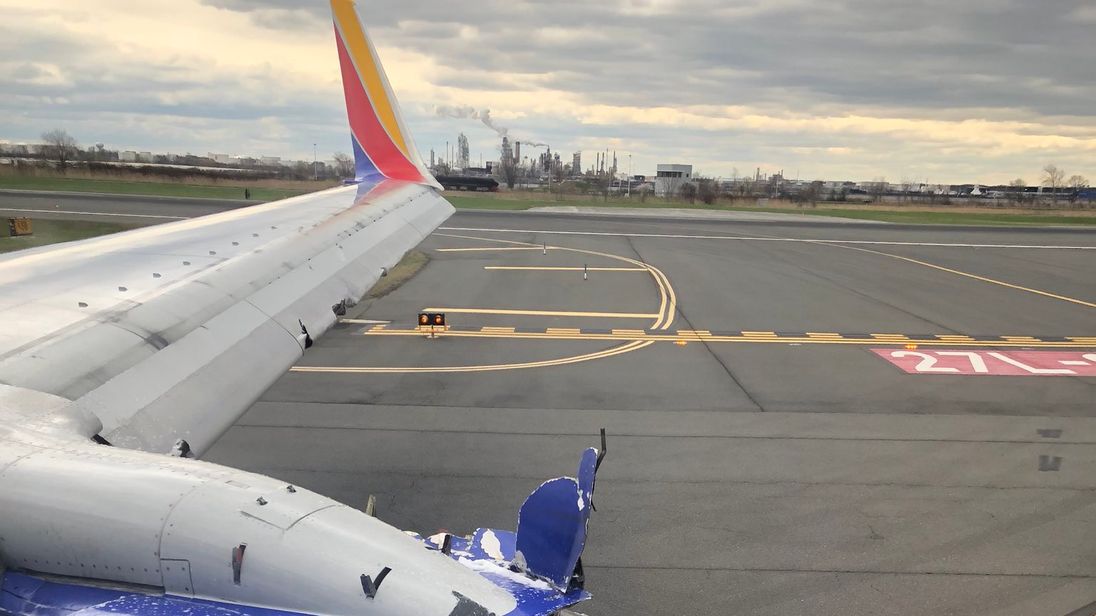
A passenger posted a photo of the damaged engine. Pic: @joeasaprap
Image:A passenger posted a photo of the damaged engine. Pic: @joeasaprap
  •  
  •  
  •  
A woman was partially sucked out of a plane after a window exploded in mid-air, according to media reports in the US.
Officials have also reported that one person has died after the damaged aeroplane was forced to make an emergency landing at Philiadelphia International Airport on Tuesday.
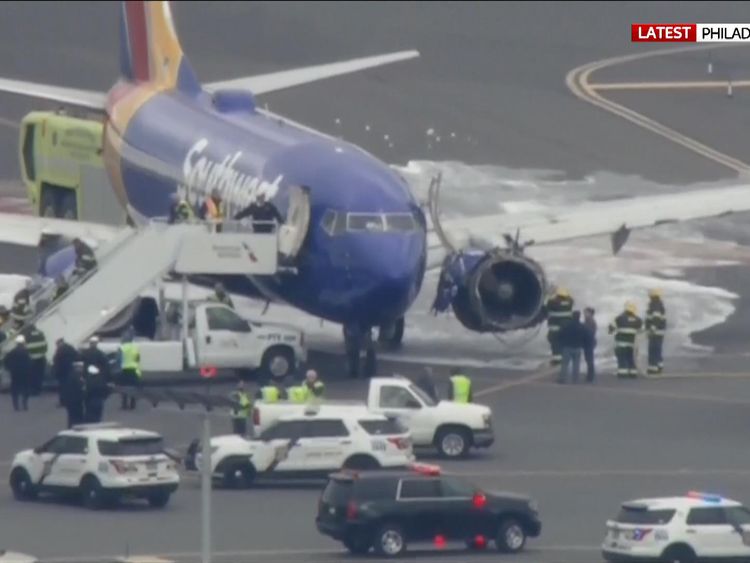
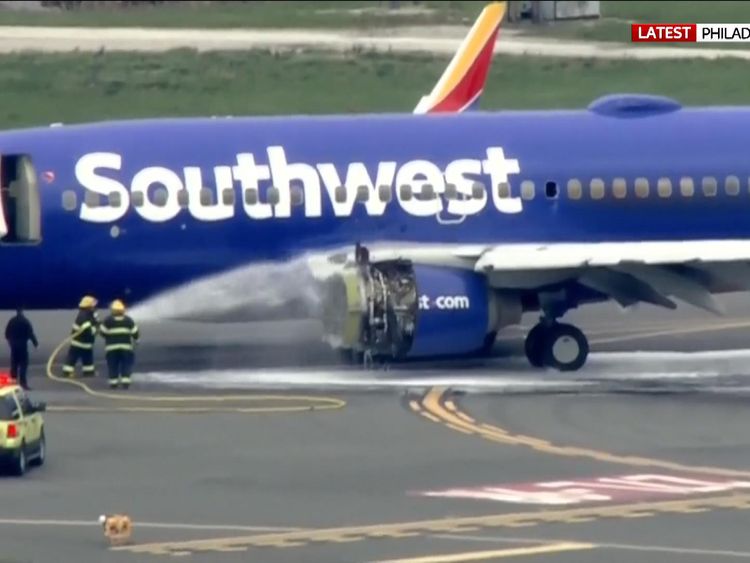
Passengers were seen walking off the plane and on to the tarmac with firefighters attending the left engine of the Southwest Airlines plane.
The plane had taken off from New York City
Image:The plane had taken off from New York City
Some tweeted that they were en route from New York City to Dallas when something went wrong with the plane, forcing pilots to make an emergency landing.
Tracking information from flightaware.com showed the plane making an abrupt turn towards Philadelphia after heading west over the south of New York.
The father of one of the passengers told NBC10 that a female passenger was partially sucked out of the aircraft in mid-air.
Firefighters attending the aircraft at Philadelphia International Airport
Image:Firefighters attending the aircraft at Philadelphia International Airport
"One passenger, a woman, was partially... was drawn out towards the out of the plane... was pulled back in by other passengers," Todd Baur said.
It is not clear if the person who died is the woman Mr Baur referred to.
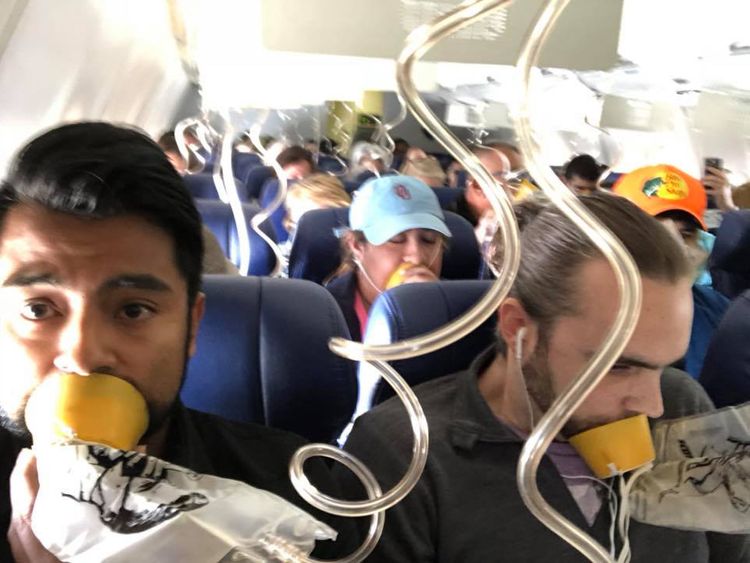
Oxygen masks came down during the incident. Pic: Facebook/Marty Martinez
Image:Oxygen masks came down during the incident. Pic: Facebook/Marty Martinez
Another passenger said in a Facebook post that a window was damaged after a problem with the aircraft's left engine.
Marty Martinez also posted photos of a damaged window and the oxygen masks which had come down during the flight.
In a statement posted to Twitter, Southwest Airlines said there were 143 passengers on board, along with five crew members.
"We are in the process of gatheirng more information. Safety is always our top priority at Southwest Airlines, and we are working diligently to support our custimers and crews at this time," it said.

Tuesday, 3 April 2018

Oh Dear Oh Dear Oh Dear!!! BRING IT ON!!


British Airways Is Canceling Flights To Oakland

In March 2017, British Airways added 4x weekly flights between London Gatwick and Oakland. British Airways has added an incredible amount of service to the US lately, seemingly with a couple of different purposes.
They’ve been successful adding service to some secondary markets out of London Heathrow, like Austin, Nashville, New Orleans, San Diego, and San Jose, for example. They’ve also tried to compete head on with Norwegian, by adding routes from London Gatwick to Fort Lauderdale and Oakland. While I think the expansion out of Heathrow has been brilliant, I’ve questioned their strategy of competing directly with Norwegian.
When you look at British Airways’ service to California at this point, they fly to Los Angeles, Oakland, San Diego, San Francisco, and San Jose. That’s an incredible amount of capacity, especially when you consider that Los Angeles gets 3x daily flights and San Francisco gets 2x daily flights.
I don’t remember the last time that British Airways canceled a US route, though it’s finally happening. British Airways will be canceling flights to Oakland as of October 20, 2018. The flight has been removed from the winter schedule, so it remains to be seen whether it will return at some point next year (though personally I doubt it). Many have reported that the loads on this flight have been extremely low, which doesn’t come as much of a surprise.
British Airways also added flights between London Gatwick and Fort Lauderdale around the same time, and I wonder if that route is doing any better. They also fly to Miami, Orlando, and Tampa, so it seems like there’s a lot of capacity there. However, Florida does have special appeal for Europeans, so maybe that route is a bit more sustainable.
I continue to question British Airways’ strategy to compete directly with Norwegian. They can’t compete on cost, so offering a slightly better (but still shabby) product while charging more just doesn’t seem sustainable. That doesn’t even address whether or not it actually makes sense to compete with Norwegian. Norwegian is cash-strapped and isn’t doing well financially, so I’m not sure what British Airways is trying to gain here.
Are you surprised to see British Airways pull out of Oakland?